
Get analysis, insight & opinions from the world's top marketers.
Sign up to our newsletter.

The EU Pledge is a commitment by leading food & beverage companies to the European Commission’s Platform for Action on Diet, Physical Activity and Health, supported by the World Federation of Advertisers (WFA).
Log in to view the 2017 Factsheet.

In line with the Terms of Reference of the EU Platform for Action on Diet, Physical Activity and Health, EU Pledge signatories are required to monitor and report on the implementation of their commitments. EU Pledge member companies have committed to carry out independent, third-party compliance monitoring of the two central EU Pledge commitments every year in a representative sample of EU Member States.
To view the annual reports please log in to your account.

Priorities for WFA regarding the AVMSD revision.

Meeting materials for WFA members.

Food marketing is under increasing pressure around the globe. This 2017 C-suite overview gives a birds-eye view of the latest developments.
Log in to view this content.

Multiple countries worldwide, including China, Vietnam and Cambodia are reviewing their regulatory frameworks for advertising. There is no global one-size-fits-all approach to advertising standards; every country will craft a regulatory framework according to domestic legal and cultural specificities. But the core components for effective and responsible advertising standards remain the same.
This toolkit makes the case for advertising self-regulation, identifying the core building blocks drawing on case studies from Brazil, India and the Philippines.
Member-only content, please log in to view this toolkit.

This study uses interviews with advertisers, publishers and technology companies to help identify the role of data in digital advertising.
This 2017 online survey contains responses from over 11,000 internet users across 11 EU countries. Responses cover the types of content users accessed online, their attitudes to data-driven advertising, and their willingness to pay for content as an alternative to advertising.

This analysis used publicly available data, including Gross Domestic Product (GDP) and employment data. It includes digital advertising’s direct contribution through Gross Value Added, as well as its indirect, induced and wider effects.
Log in to view this content.

WFA member survey on how members are evaluating the impact of GDPR on their business.

This guide, developed with the support of Hunton & Williams LLP, aims to help address this gap by highlighting five key areas of GDPR which marketers should be aware of in order to prepare.

Created by the EVSG (European Viewability Steering Group - made up of WFA, EACA and IAB Europe), these principles are designed to ensure that harmonised best practice standards and guidelines are applied to the measurement and trading of viewable digital advertising across all markets in Europe (and beyond). They are designed to help our industry to achieve the following common goals:
1. To raise minimum quality standards in digital advertising measurement for all stakeholders across Europe.
2. To measure digital ad exposure which is deemed a key step to increasing confidence in digital ad trading.
3. To enhance the (internet) user experience in the context of changing user expectations.
4. To improve confidence in the digital ad environment.

In this webinar, the Coalition for Better Ads will present the Better Ads Standards and the Coalition’s journey.

On 20 June, UN Women in partnership with Unilever and industry leaders including WPP, IPG, facebook, Google, Mars, Microsoft, J&J and WFA, announced the launch of the Unstereotype Alliance – a new global Alliance set to banish stereotypical portrayals of gender in advertising and all brand led content.
WFA member survey. For additional details, please log in.
WFA member survey. For additional details, please log in.

An overview of some of the key elements of the proposed ePrivacy revision.
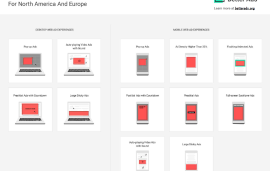
The Coalition for Better Ads has released initial Better Ads Standards for desktop and mobile web that reflect consumer advertising preferences in North American and European markets. The initial Better Ads Standards are based on research during which consumers were asked to read articles on simulated high quality content pages, and then to rate comparatively the different ad experiences they received. Over 25,000 consumers rated 104 ad experiences for desktop web and mobile web. The Coalition’s research identifies the ad experiences in both North America and Europe that ranked lowest across a range of user experience factors, and that are most highly correlated with an increased propensity for consumers to adopt ad blockers. These results define initial Better Ads Standards that identify the ad experiences that fall beneath a threshold of consumer acceptability.
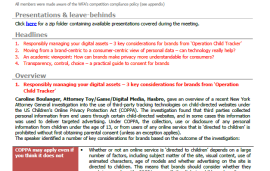
Overview of the Digital Governance Exchange (DGX) meeting held February 2017 in London.
There is increasing pressure on alcohol producers in light of marketing’s perceived role in encouraging underage consumption.

WFA CEO Stephan Loerke reflects on the year 2016
